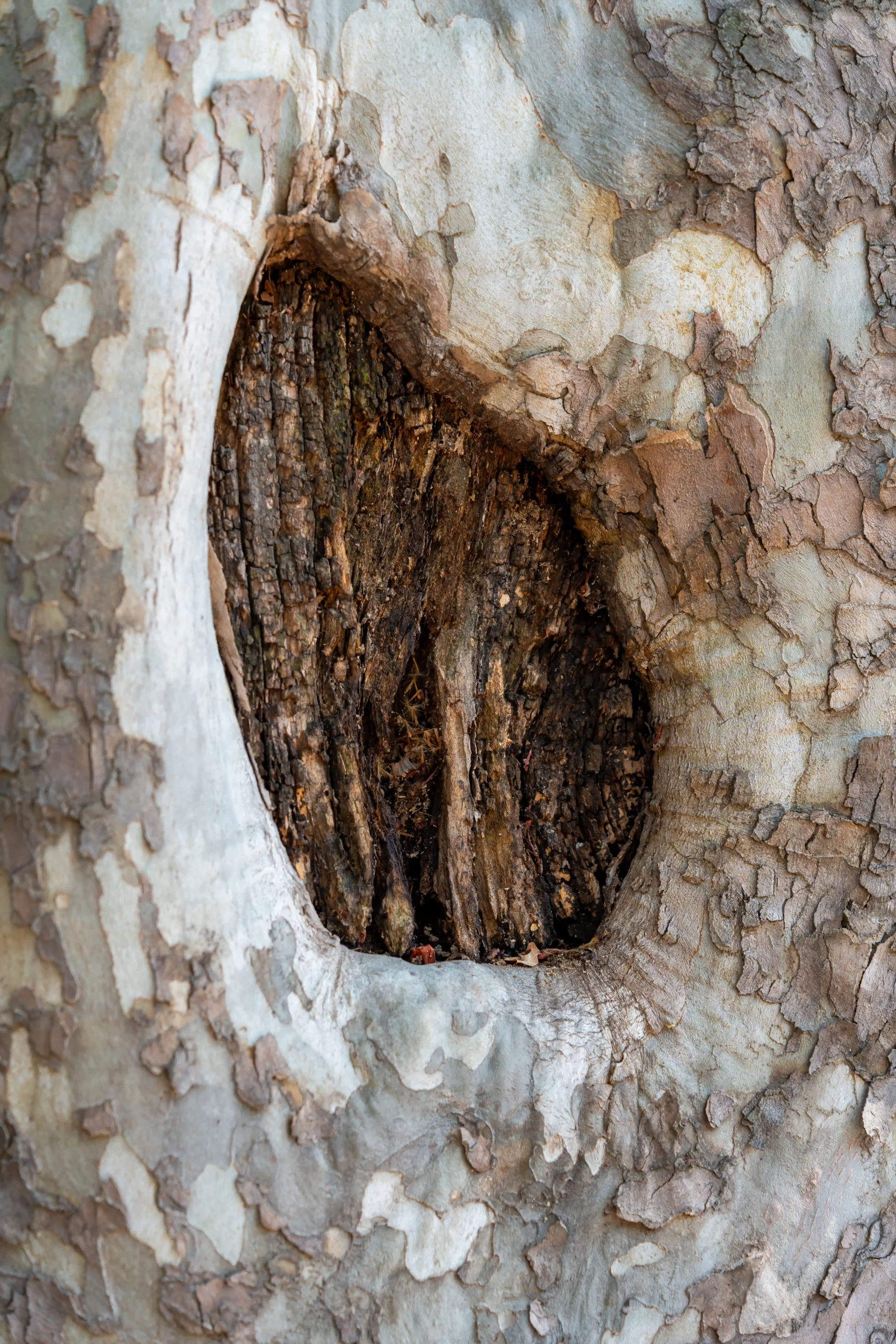
You’re walking around your yard when you notice it: a hole in the trunk of one of your trees.
Perhaps it’s small. Maybe it’s big enough to stick your hand into, and you’ve noticed mushrooms nearby, some missing bark, or a section of the trunk that looks like it’s starting to break down. So… should you be worried?
Not necessarily. But a cavity is definitely something worth paying attention to.
Tree cavities are often connected to old injuries and decay within the tree. That injury could have come from a broken branch, storm damage, improper pruning, construction damage, or another wound that allowed decay organisms to get inside your beloved tree. Over time, the affected wood can break down and leave behind a hollow area.
The tricky part here is that you can’t always tell from the outside how much decay is happening inside.
What Causes a Tree Cavity?
Trees, as much as we love them, do take on a lot of abuse over their lifetimes. A major storm can rip off a limb, or a mower can damage the trunk without you even realizing. An old pruning cut can become a place where decay begins. Even a branch that broke years ago can eventually lead to a cavity.
Once the tree is injured, fungi and other organisms can begin breaking down the damaged wood.
Trees do have natural defenses against decay. They can compartmentalize damaged areas, essentially creating barriers that help limit the spread of decay into healthier parts of the tree, which means a cavity doesn’t automatically mean the entire tree is dying.
A Hole Doesn’t Always Mean “Take the Tree Down”
This is one of the biggest misconceptions about tree cavities. Some trees with cavities continue growing for many years. The presence of decay alone doesn’t tell you exactly how structurally sound a tree is. What matters more is the bigger picture. A trained arborist will consider things like:
- How large is the cavity?
- Where is it located?
- Is it in the trunk, near the base, or at a major branch union?
- How much sound wood remains around it?
- Are there cracks or splits nearby?
- Is the tree leaning?
- Are there mushrooms or fungal growth?
- Is the tree showing signs of declining health?
- What is located underneath or near the tree?
The location of the cavity matters because decay near a major branch union or near the base of the tree can create different structural concerns than a smaller cavity in another part of the tree.
What Other Warning Signs Should You Look For?
A cavity is just one piece of the puzzle. While you’re looking at your trees this fall, keep an eye out for other signs that something may be going on, including things like mushrooms on the trunk, branches, or around the base, which can indicate internal decay.
You should also look out for cracks or splits, which can be a warning sign of structural problems. Likewise, loose or damaged bark can also indicate previous injury or ongoing problems
Another tree issue to watch out for isunusual swelling or growths around a damaged area, which can sometimes point to the tree itself growing around internal defects.
Keep in mind, none of these signs should be used by themselves to diagnose a tree, but are instead reasons to take a closer look.
Should You Fill the Hole?
If you find a cavity, you might be tempted to grab some expanding foam, concrete, or another material and fill it.
Don’t.
Older tree-care practices sometimes involved filling cavities with concrete. Modern arboricultural guidance does not recommend filling cavities as a way to restore structural strength. Materials such as concrete or expanding foam don’t replace the structural wood that has already been lost and can create additional problems.
What Should You Do If You Find a Cavity?
If the cavity is large, appears to be getting worse, is accompanied by cracks or fungal growth, or is located on a tree near your home or another area where people spend time, it’s worth having the tree evaluated by a qualified tree professional, like our team here at Bergholz’s Tree Experts.
An inspection can help determine whether the tree can continue to be maintained, whether specific limbs need to be removed, or whether the tree presents a larger structural concern.